
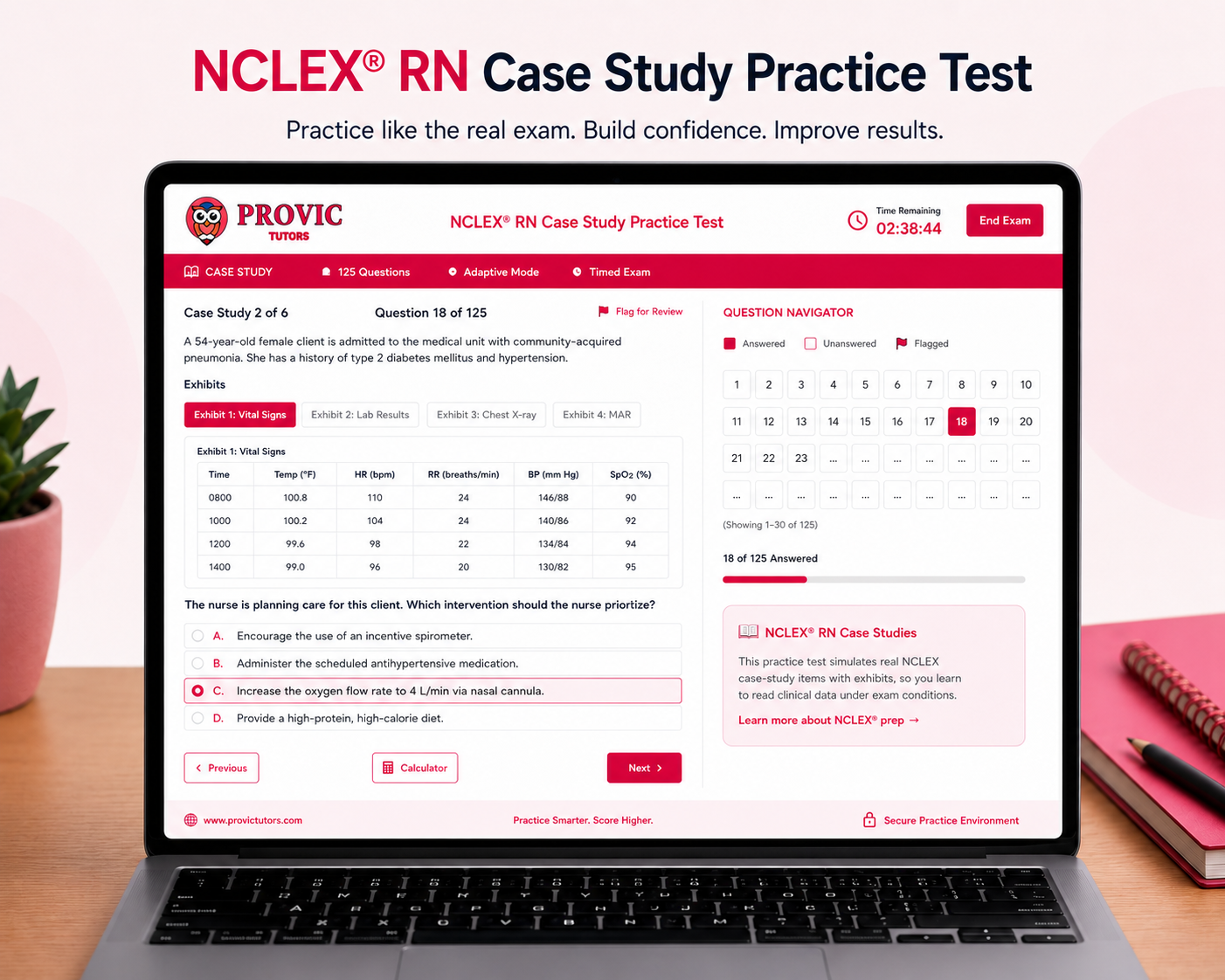

About the NCLEX-RN Exam
The NCLEX-RN (National Council Licensure Examination for Registered Nurses) is the exam every nursing graduate must pass to become a licensed RN in the U.S. or Canada. Administered by the National Council of State Boards of Nursing (NCSBN), it doesn't just test recall — it measures whether you can apply nursing knowledge to make safe clinical decisions.
The exam now runs on the Next Generation NCLEX (NGN) format, which uses case-study clusters and new question types (select-all-that-apply, drag-and-drop, matrix/grid, drop-down) alongside traditional multiple choice, with partial-credit scoring on case studies.
Because every state board relies on the same exam for licensure, passing the NCLEX-RN is the single gate standing between a nursing degree and practicing as an RN. That's exactly why so many candidates search for a reliable NCLEX-RN practice test weeks before their scheduled exam date — early, targeted practice under realistic conditions is the most reliable way to walk in prepared.
How the NCLEX-RN Exam Works (Format & Scoring)
The NCLEX-RN is a computer adaptive test (CAT): question difficulty adjusts in real time based on your performance, so no two candidates sit the same exam.
- Questions: 85–150, including unscored pretest items and Next Gen case studies
- Time limit: up to 5 hours, including breaks
- Ending condition: the exam stops once the system is 95% confident you're clearly above or below the passing standard — or at the 150-question maximum
- Scoring: pass/fail only — there's no percentage score. Your ability estimate is compared statistically against NCSBN's passing standard
- Lab values: not provided on-screen; candidates are expected to know normal reference ranges
Getting more questions doesn't mean you're failing — it usually means the system needs more data to be confident either way.
NCLEX-RN Practice Test Overview
This NCLEX-RN practice test is built to the official NCSBN test plan in both structure and difficulty. Every question is written to reflect the current NCSBN test plan and Next Gen item types, and every answer comes with a rationale explaining not just what's correct, but why the other options are wrong — including the clinical reasoning behind each distractor.
Unlike generic quiz banks, this question set is organized by Client Needs category, matching the official test plan's weighting — so you can drill your weakest area instead of guessing where to focus. Whether you want a full-length, timed NCLEX-RN simulation or a short set of NCLEX practice questions between shifts, the format adapts to how you study.
Each attempt is timed, scored, and reviewable, so you get exam-day pressure without exam-day stakes.
Topics Covered in This NCLEX-RN Practice Test
The question bank is divided into the same four Client Needs categories used on the official NCLEX-RN test plan:
- Safe and Effective Care Environment — Management of Care and Safety & Infection Control. The highest-weighted category on the exam.
- Health Promotion and Maintenance — growth and development, prevention, and early detection of health problems.
- Psychosocial Integrity — coping, mental health concepts, and support for patients and families in crisis.
- Physiological Integrity — basic care and comfort, pharmacology, risk reduction, and physiological adaptation.
Every practice question includes a full rationale, so incorrect answers become learning opportunities instead of dead ends. If you're also preparing for entrance exams or other licensure steps, our ATI TEAS practice tests, HESI A2 practice tests, and NCLEX-PN practice questions follow the same detailed-rationale format.
Registering, Scheduling & Retaking the NCLEX-RN
Practice questions are only half the picture — knowing the logistics avoids costly delays:
- Registration: apply with your state's Nursing Regulatory Body, register with Pearson VUE ($200 USD / $360 CAD), then wait for your Authorization to Test (ATT)
- Scheduling: book your exam at a Pearson VUE test center once your ATT arrives — the NCLEX-RN cannot be taken at home or remotely
- Results: unofficial Quick Results are available ~48 hours after testing for a $7.95 fee; official results come from your state board within 2 days to 6 weeks — see how NCLEX results work
- Retakes: if you don't pass, you must wait a minimum of 45 days (60–90 in some states) before retesting, and you'll pay the $200 registration fee again — see full state-by-state retake rules
Use your Candidate Performance Report (CPR) — the category-by-category breakdown you get after a fail — to target your retake study plan instead of repeating your original prep.
How to Prepare for the NCLEX-RN Exam
Effective NCLEX-RN prep is less about cramming and more about deliberate, targeted practice:
- Start with a diagnostic. Take one full-length NCLEX-RN practice test cold, so you know which Client Needs categories need the most attention.
- Practice by category, then mix it up. Early in your prep, isolate weak categories with targeted practice questions. As your exam date approaches, switch to full-length, mixed-category simulations that reflect real pacing.
- Read every rationale — even for correct answers. The explanation often reveals the clinical reasoning you need for Next Gen case studies, not just the "right" answer.
- Practice Next Gen item types deliberately. Select-all-that-apply, drag-and-drop, and case-study clusters behave differently from standard multiple choice — don't wait until test day to see one for the first time.
- Memorize core lab values. They're not provided during the exam, so build recall now rather than during a case study.
- Use a free preview to build confidence first. If you're new to the NGN format, a short preview removes the intimidation factor before committing to full-length sessions.
Most candidates who prepare consistently for 6–8 weeks using realistic, rationale-backed NCLEX-RN practice questions walk into test day with noticeably more confidence and better pacing.