
The ATI Dosage Calculation and Safety 3.2 assessments look different by specialty, but they share the same handful of calculations — the specialty changes the drugs, the patient and the units; it does not change the math. This guide walks through every version, the formulas behind them, and 25 worked practice questions.
For level requirements, passing scores and retake policies that apply across ATI's proctored exams, see the ATI proctored exam guide.
Pick your ATI dosage calculation 3.2 practice test
PN Dosage Calculations - Fundamentals 3.2
Unit conversions, tablets, oral liquids, IM/subcut volumes, basic IV rates, rounding.
Start practicing → RNFundamentalsRN Dosage Calculations - Fundamentals 3.2
Conversions, oral & injectable doses, mL/hr and gtt/min, infusion time, safe dose checks.
Start practicing → PNMental HealthPN Dosage Calculations - Mental Health 3.2
Oral concentrates, STAT/PRN IM doses, tablet math, cumulative PRN maximums.
Start practicing → RNMental HealthRN Dosage Calculations - Mental Health 3.2
Concentrates, long-acting injectables, IV push timing, reconstitution, cumulative dosing.
Start practicing → RNPediatricsRN Dosage Calculations - Pediatrics 3.2
mg/kg dosing, safe dosage ranges, BSA, pediatric IV and maintenance fluids.
Start practicing → RNPediatricsRN Dosage Calculations - Pediatrics 3.2 (Q&A edition)
35 pediatric dosage questions with worked answers and rationales (Carrington set).
Start practicing → RNMaternal NewbornRN Dosage Calculations - Maternal Newborn 3.2
Oxytocin mU/min → mL/hr, magnesium sulfate g/hr, newborn mg/kg and tiny IM volumes.
Start practicing →What is the ATI dosage calculation proctored assessment 3.2?
ATI's Dosage Calculation and Safety series is proctored and split by specialty, with separate RN and PN versions. The specialties in the series are:
- Fundamentals
- Mental Health
- Pediatric Nursing
- Maternal Newborn
- Adult Medical-Surgical and Critical Care (heparin, insulin, titrated drips)
Nursing programs often set a benchmark of 90% or higher — sometimes 100% — with a limited number of attempts.
How the specialty assessments compare
| Skill | Fundamentals | Mental Health | Pediatrics | Maternal Newborn |
|---|---|---|---|---|
| Unit conversions | ●●● | ●● | ●●● | ●● |
| Tablets / capsules | ●●● | ●●● | ● | ● |
| Oral liquids & concentrates | ●● | ●●● | ●●● | ● |
| IM / subcutaneous volumes | ●● | ●●● | ●● | ●●● |
| Weight-based (mg/kg) | ● | ● | ●●● | ●●● |
| Safe dosage range | ●● | ●● | ●●● | ●● |
| IV mL/hr and gtt/min | ●●● | ● | ●● | ●●● |
| Unit-based infusions | ● | — | ● | ●●● |
| Reconstitution | ● | ●● | ●● | ● |
| Cumulative / PRN maximums | ● | ●●● | ● | ● |
●●● constant · ●● often · ● occasional · — none
RN vs PN: both use the same methods. RN versions lean further into IV push, continuous infusions and reconstitution — see RN Mental Health 3.2. PN versions emphasize oral, IM and subcutaneous doses with simpler IV rates — see PN Mental Health 3.2.
Core skills every 3.2 assessment tests
| 1 g = 1,000 mg | 1 tsp = 5 mL | 1 kg = 2.2 lb (lb ÷ 2.2 = kg) |
| 1 mg = 1,000 mcg | 1 tbsp = 15 mL | 1 kg = 1,000 g |
| 1 L = 1,000 mL | 1 oz = 30 mL | 1 hr = 60 min |
| 1 unit = 1,000 milliunits | 1 cup = 240 mL | 1 day = 24 hr |
Dimensional analysis chains these conversion factors together so the unwanted units cancel out, leaving only the unit you need — it's the most reliable way to check that a setup is correct before you calculate.
Order: digoxin 0.25 mg PO. Available: 125 mcg tablets. How many tablets should you give?
0.25 mg × 1,000 mcg/mg = 250 mcg250 mcg ÷ 125 mcg/tab = 2 tablets2 tablets
Fundamentals dosage calculation 3.2 (RN & PN)
The Fundamentals assessment is the broadest of the series and the best place to start — it sets the baseline every other specialty builds on.
What's emphasized:
- Unit conversions
- Tablets
- Oral liquids
- IM/subcut injections
- IV mL/hr, gtt/min, and completion time
- Safe-dose and adult weight-based doses
Order: furosemide 60 mg PO. Available: 20 mg tablets. How many tablets?
60 mg ÷ 20 mg/tab = 3 tablets3 tablets
Order: acetaminophen 650 mg PO. Available: 160 mg/5 mL suspension. How many mL (nearest tenth)?
(650 ÷ 160) × 5 = 20.31 mLRounded to the nearest tenth = 20.3 mL20.3 mL
Order: morphine 4 mg IV. Available: 10 mg/mL. How many mL?
4 mg ÷ 10 mg/mL = 0.4 mL0.4 mL
Order: 1,200 mL NS to infuse over 10 hours. Drop factor 15 gtt/mL. What is the rate in gtt/min?
1,200 mL ÷ 10 hr = 120 mL/hr120 mL/hr ÷ 60 min/hr = 2 mL/min2 mL/min × 15 gtt/mL = 30 gtt/min30 gtt/min
An infusion of 1,000 mL D5W is running at 125 mL/hr, started at 0800. What time will it finish?
1,000 mL ÷ 125 mL/hr = 8 hours0800 + 8 hours = 1600Order: gentamicin 1.5 mg/kg IV. Patient weighs 132 lb. How many mg should the patient receive?
132 lb ÷ 2.2 = 60 kg60 kg × 1.5 mg/kg = 90 mg90 mg
Order: heparin 1,000 units/hr IV. Available: 25,000 units in 500 mL. What is the pump rate in mL/hr?
25,000 units ÷ 500 mL = 50 units/mL1,000 units/hr ÷ 50 units/mL = 20 mL/hr20 mL/hr
Practice the full Fundamentals set. Work every calculation type above with answers and rationales.
Mental health dosage calculation 3.2 (RN & PN)
Psychiatric units rely heavily on oral concentrates and IM injections, and PRN maximums matter more here than in almost any other setting.
- Oral concentrates and their calibrated syringes
- STAT and PRN intramuscular doses
- Standard tablet math
- Cumulative PRN maximums across a shift or 24-hour period
Order: sertraline 50 mg PO. Available: oral concentrate 20 mg/mL. How many mL?
50 mg ÷ 20 mg/mL = 2.5 mL2.5 mL
Measure with the calibrated oral syringe supplied with the concentrate and dilute per the product label.
Order: lithium citrate 16 mEq PO BID. Available: 8 mEq/5 mL syrup. How many mL per dose?
(16 mEq ÷ 8 mEq) × 5 mL = 10 mL10 mL
Order: olanzapine 7.5 mg IM. The vial is reconstituted to 5 mg/mL. How many mL?
7.5 mg ÷ 5 mg/mL = 1.5 mL1.5 mL
Order: divalproex DR 750 mg PO. Available: 250 mg delayed-release tablets. How many tablets?
750 mg ÷ 250 mg/tab = 3 tablets3 tablets
Never split or crush delayed-release (DR) or extended-release (ER) tablets.
Order: haloperidol 5 mg IM q4h PRN, maximum 20 mg/24 hr. The patient already received doses at 0200, 0700 and 1200 (15 mg total). Can another dose be given at 1700? At 2100?
15 mg given so far + 5 mg at 1700 = 20 mg — reaches the 24-hour maximumNo further dose may be given until the 24-hour window resets, so the 2100 dose must be heldOrder: lorazepam 1 mg IV push. Available: 2 mg/mL. Maximum push rate 2 mg/min. How many mL should you draw up?
1 mg ÷ 2 mg/mL = 0.5 mL0.5 mL
At 2 mg/min maximum this dose could be pushed in about 30 seconds. Many facility policies dilute the dose and push it over 1–2 minutes — follow the question and your policy.
Practice the full Mental Health set. Concentrates, PRN math and reconstitution, worked out.
Pediatric nursing dosage calculation 3.2 (RN)
Pediatrics is often the hardest test in the series, because every question adds steps: a weight-based dose, then a safe-range check, then a conversion into the volume you'll actually give.
- mg/kg dosing from a weight in kg or lb
- Safe dosage range verification
- Body surface area (BSA) calculations
- Pediatric IV and maintenance fluid rates
Order: cefazolin 250 mg IV q8h. Child weighs 33 lb. Safe range is 25–50 mg/kg/day.
33 lb ÷ 2.2 = 15 kgSafe range: 15 kg × 25–50 mg/kg/day = 375–750 mg/dayOrdered: 250 mg × 3 doses/day = 750 mg/day — at the top of, but within, the safe rangeOrder: ibuprofen 10 mg/kg. Patient weighs 12 kg. Available: 100 mg/5 mL suspension. How many mL?
12 kg × 10 mg/kg = 120 mg(120 mg ÷ 100 mg) × 5 mL = 6 mL6 mL
Patient is 120 cm tall and weighs 25 kg. The adult dose is 100 mg. Using BSA (Mosteller) and a 1.73 m² adult reference, what is this patient's dose (nearest tenth)?
BSA = √[(120 × 25) ÷ 3,600] = √0.833 = 0.91 m²(0.91 ÷ 1.73) × 100 mg = 52.6 mg52.6 mg
Using the Holliday-Segar method (100/50/20 mL/kg), what is the maintenance IV rate in mL/hr for a 24 kg child (nearest whole number)?
First 10 kg × 100 mL/kg = 1,000 mLNext 10 kg × 50 mL/kg = 500 mLRemaining 4 kg × 20 mL/kg = 80 mLTotal 1,580 mL ÷ 24 hr = 65.8 ≈ 66 mL/hr66 mL/hr
Order: ampicillin 500 mg in 25 mL to infuse over 30 minutes by pump. What is the rate in mL/hr?
25 mL ÷ 0.5 hr = 50 mL/hr50 mL/hr
There are two RN Pediatrics 3.2 practice tests on this page: the main test above, which includes a free preview and this guide, and a separate 35-question Q&A set from the Carrington College collection for a second full round of practice.
Get a second full round of pediatric practice. A separate 35-question set with answers and explanations.
Maternal newborn dosage calculation 3.2 (RN)
This assessment splits into two very different number ranges: the maternal side runs on infusions measured in mU/min and g/hr, while the newborn side runs on tiny weight-based doses measured in kilograms and fractions of a mL.
- Oxytocin titration in milliunits per minute
- Magnesium sulfate infusions in grams per hour
- Newborn weight-based doses and very small IM volumes
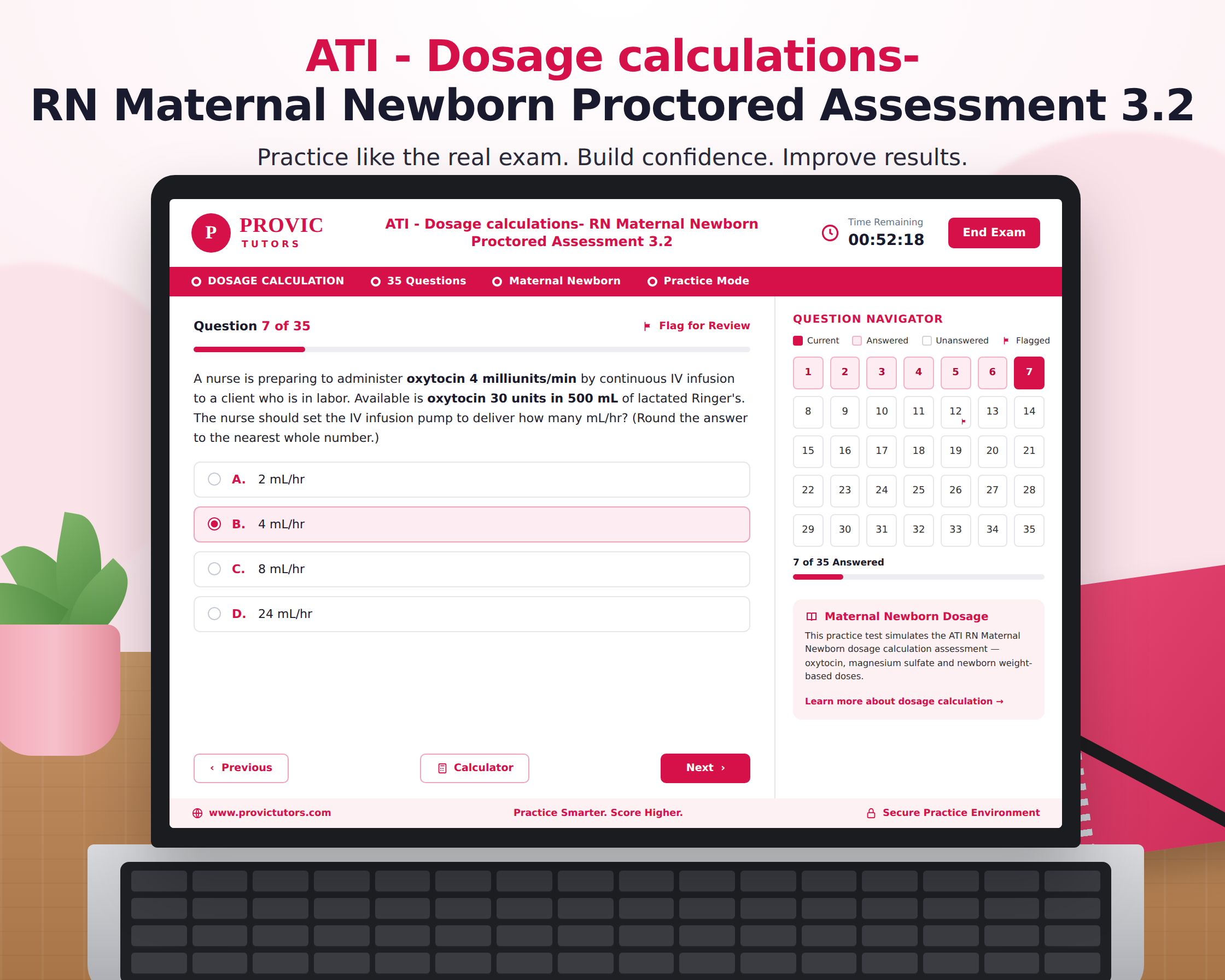
Order: oxytocin infusion at 4 milliunits/min. Available: 30 units in 500 mL LR. What is the pump rate in mL/hr?
30 units × 1,000 = 30,000 mU ÷ 500 mL = 60 mU/mL4 mU/min × 60 min/hr = 240 mU/hr240 mU/hr ÷ 60 mU/mL = 4 mL/hr4 mL/hr
With this exact concentration (30 units/500 mL), mU/min and mL/hr turn out to be numerically equal — don't count on that outside this concentration.
Order: magnesium sulfate infusion at 2 g/hr. Available: 20 g in 500 mL. What is the pump rate in mL/hr?
20 g ÷ 500 mL = 0.04 g/mL2 g/hr ÷ 0.04 g/mL = 50 mL/hr50 mL/hr
Using the same 20 g/500 mL bag, a loading dose of 6 g is ordered to infuse over 20 minutes. What is the pump rate in mL/hr?
0.04 g/mL → 6 g ÷ 0.04 g/mL = 150 mL over 20 minutes150 mL × 3 (to scale 20 minutes up to 60 minutes) = 450 mL/hr450 mL/hr
Order: terbutaline 0.25 mg subcut. Available: 1 mg/mL. How many mL?
0.25 mg ÷ 1 mg/mL = 0.25 mL0.25 mL
Order: ampicillin 50 mg/kg IM q12h. Newborn weighs 3,400 g. Available: 250 mg/mL. How many mL (nearest hundredth)?
3,400 g = 3.4 kg3.4 kg × 50 mg/kg = 170 mg170 mg ÷ 250 mg/mL = 0.68 mL0.68 mL
Order: phytonadione (vitamin K) 1 mg IM for a term newborn. Available: 1 mg/0.5 mL. How many mL?
(1 mg ÷ 1 mg) × 0.5 mL = 0.5 mL0.5 mL
Practice the full Maternal Newborn set. Oxytocin, magnesium sulfate and newborn dosing, worked out.
Rounding rules that cost students points
| Situation | Rule | Example |
|---|---|---|
| Volume ≥ 1 mL | Round to the nearest tenth | 2.46 → 2.5 mL |
| Volume < 1 mL | Round to the nearest hundredth | 0.684 → 0.68 mL |
| Gravity rate | Round to a whole drop | 20.8 gtt/min → 21 gtt/min |
| Pump rate | Whole number, or nearest tenth if asked | 83.3 → 83 mL/hr |
| Weight conversion | Round to the nearest tenth | 45 lb → 20.45 → 20.5 kg |
| Tablets | Whole or half tablet (scored tablets only) | — |
- Round once, at the very end of the calculation — not at each intermediate step.
- Use a leading zero and no trailing zero: write 0.5 mL and 5 mL, not .5 mL or 5.0 mL.
The 10 most common dosage calculation mistakes
- Multiplying pounds by 2.2 instead of dividing.
- Confusing a mg/kg/dose order with a mg/kg/day order.
- Missing an mcg↔mg or unit↔milliunit conversion.
- Mixing up hours and minutes when calculating gtt/min.
- Reading an oral concentrate's strength as if it were a dilute solution.
- Rounding too early, before the final step.
- Forgetting to add prior PRN doses when checking a cumulative maximum.
- Answering in mg when the question asked for mL (or vice versa).
- Splitting an unscored tablet or an extended-release (ER) tablet.
- Skipping the sanity check on the final answer.
How to prepare: a 2-week study plan
| Days | Focus | Practice |
|---|---|---|
| 1–3 | Conversions and core formulas | RN Fundamentals 3.2 / PN Fundamentals 3.2 |
| 4–6 | IV rates, infusion times, unit-based infusions | Formula boxes above + practice questions 5, 8, 19–22 |
| 7–10 | Specialty high-yield question types | RN Mental Health, PN Mental Health, Pediatrics, Maternal Newborn |
| 11–12 | Review every miss, re-work it without the rationale | Pediatrics Q&A set |
| 13 | Full timed run-through | — |
| 14 | Light review and rest | — |
If you're preparing for several specialties at once, work through Fundamentals once, then rotate the remaining days between whichever specialty assessments your program requires.
Quick IV rate checker
Use this to check a hand-worked answer — not to replace doing the math yourself.
Practice tests by specialty
Browse all nursing school practice exams →
Glossary of dosage calculation terms
- Dimensional analysis
- A unit-conversion method that chains conversion factors so unwanted units cancel, leaving the answer in the unit you need.
- Desired over Have (D/H × Q)
- The formula method: (Desired dose ÷ Have on hand) × Quantity the "Have" comes in = amount to give.
- Drop factor
- The number of drops per mL delivered by an IV tubing set — 10, 15 or 20 gtt/mL for macrodrip tubing, 60 gtt/mL for microdrip tubing.
- Safe dosage range (SDR)
- The minimum and maximum dose considered safe for a patient, usually expressed per kg per dose or per day; an order outside this range should be clarified before giving.
- BSA (Mosteller)
- Body surface area, calculated as √[(height in cm × weight in kg) ÷ 3,600], used to scale certain doses to an individual patient.
- Oral concentrate
- A high-strength oral liquid (for example 20 mg/mL) that must not be confused with a lower-strength oral solution (for example 20 mg/5 mL) of the same drug.
- Reconstitution
- Adding a diluent to a powdered medication to create a liquid of a known concentration before it is given.
- Milliunit (mU)
- One-thousandth of a unit; oxytocin orders are written in milliunits per minute and must be converted to mL/hr for the pump.
- PRN maximum
- The total dose of a PRN medication that may be given in a defined period (for example, 24 hours); every prior dose in that window counts toward the limit.
Frequently asked questions
What is the ATI Dosage Calculation Proctored Assessment 3.2?
It is part of ATI's Dosage Calculation and Safety series. There is one proctored assessment per specialty — Fundamentals, Mental Health, Pediatrics, Maternal Newborn, Adult Medical-Surgical and Critical Care — with separate RN and PN versions.
Which dosage calculation test should I take first?
Start with Fundamentals. It covers the core conversions and formulas that every later specialty assessment builds on.
How is the RN version different from the PN version?
Both use the same methods and formulas. The RN versions lean more heavily into IV therapy — IV push, continuous infusions, titration. The PN versions emphasize oral, IM and subcutaneous doses and more basic IV rates.
What is the hardest specialty dosage calculation test?
Most students find Pediatrics and Maternal Newborn the hardest, because weight-based dosing, BSA and infusion conversions stack multiple steps onto the same core formulas used in the other specialties.
What rounding rules does ATI use for dosage calculations?
Follow the rounding instruction stated in the question first — it takes priority. Where no instruction is given, use standard conventions: round mL volumes to the nearest tenth (or hundredth below 1 mL), and round drops per minute to a whole drop.
Are these the official ATI assessment questions?
No. Provic Tutors practice tests are independent study resources designed to mirror the style and calculation types found on the proctored assessments. They do not reproduce secure ATI exam content.
Should I use dimensional analysis, ratio-proportion, or the formula method?
Any method that gets you to the correct, correctly-labeled answer is acceptable. Dimensional analysis is generally the most reliable because the units themselves show you whether your setup is correct.
How many questions are on the assessment?
The number of questions varies by program and by assessment version, so check your school's ATI guidelines for the exact count. Our practice tests include full question sets with rationales for every item.
More dosage calculation practice tests
For students who have finished the 3.2 series or who are studying a course-specific medication math class, here are related practice tests.
ATI medical dosage exams
ATI Medical Dosage Exam
View practice test →ATI Medical Dosage Calculations NUR4230
View practice test →RN ATI NURS4260 Medical Dosage Calculation
View practice test →ATI NURS4260 Med Cal 2 (2025)
View practice test →HESI dosage calculation (WGU)
HESI D441 Medical Dosage Calculation – Pharmacology (WGU)
View practice test →HESI Medical Dosage Calc – Pharmacology Pre-Assessment 1 (WGU)
View practice test →HESI Medical Dosage Calc – Pharmacology Pre-Assessment 2 (WGU)
View practice test →Looking for more? All nursing school practice exams · ATI proctored exam guide · Nursing exam bundles
For educational use only. Examples on this page use standard textbook values — always verify doses against current references, your facility's policy and the prescriber's order. Provic Tutors is not affiliated with ATI; ATI® is a trademark of its respective owner, and the practice questions on this page are original. Last reviewed: October 1, 2026.