
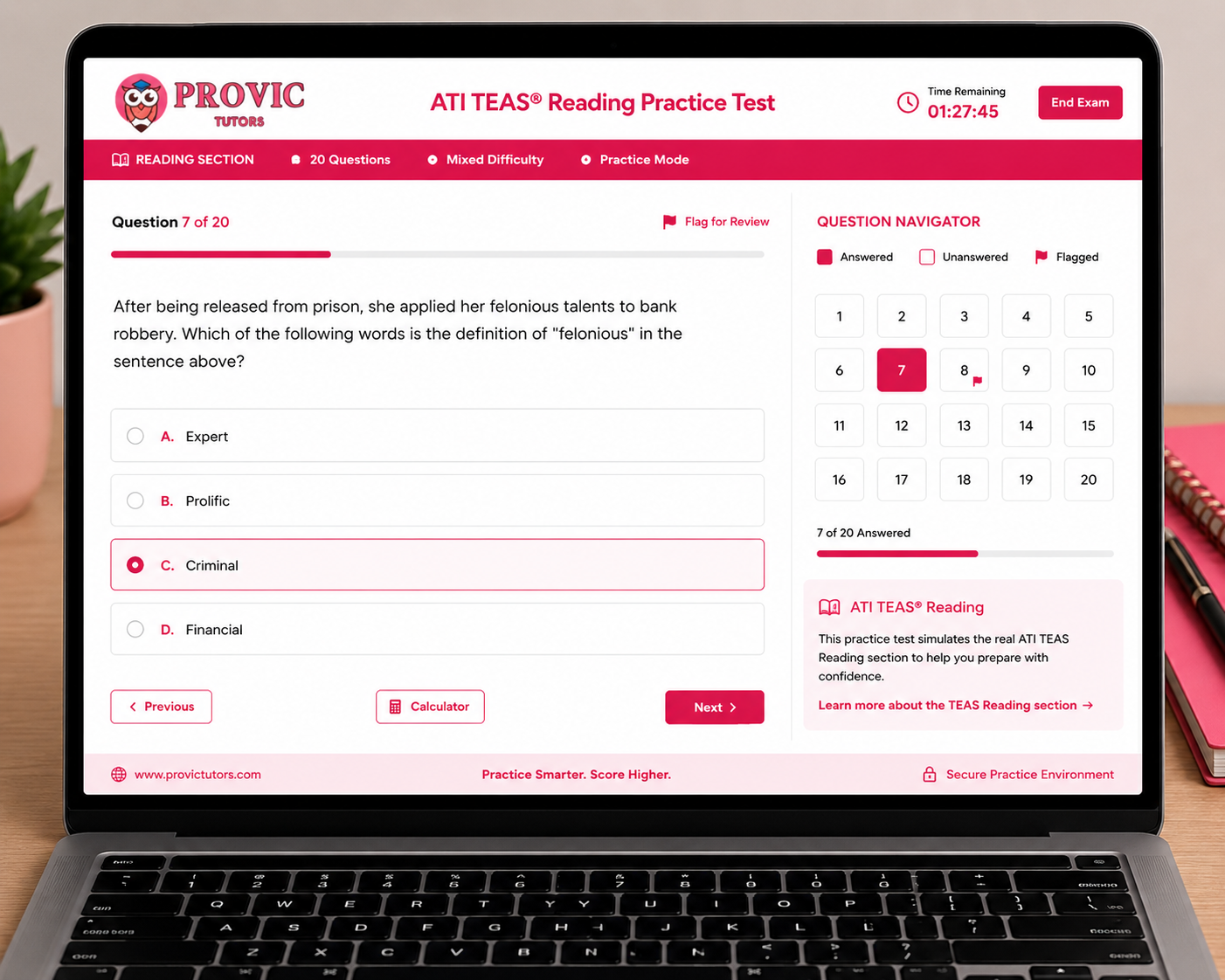
What is the HESI proctored exam?
HESI proctored exams are standardized, timed assessments developed by Elsevier (Health Education Systems Incorporated) that nursing programs use to evaluate student mastery at the end of each major course. Because every student answers questions drawn from the same nationally normed bank, a HESI score means the same thing regardless of which school administers it.
“Proctored” means the exam runs under supervised conditions — a monitored testing lab on campus, or remote proctoring software that uses a webcam, screen recording, and a locked-down browser.
Elsevier offers a HESI proctored exam for nearly every core nursing course, plus the comprehensive Exit Exam at the end of the program:
HESI A2: the entrance exam (not a subject exam)
If you’re searching for a HESI practice exam, a HESI exam practice test, or a HESI exam study guide and you haven’t started nursing coursework yet, you’re probably looking for the HESI A2 (Admission Assessment) rather than any of the subject exams below. The HESI A2 is the standardized entrance exam many nursing programs require before acceptance — it’s a different test, with different content, from the specialty and Exit exams covered on the rest of this page.
What it covers
- Math — dosage calculations, ratios, conversions, basic algebra
- Reading Comprehension — passage-based inference and main-idea questions
- Vocabulary & General Knowledge — medical terminology and general vocabulary
- Grammar — sentence structure, parts of speech, punctuation
- Anatomy & Physiology — body systems (often the most heavily weighted science section)
- Biology and/or Chemistry — required by some but not all programs
- Learning Style / Personality Profile — non-scored sections some schools include
How it’s different from the exams above
Every other exam on this page — Fundamentals, Pharmacology, Med-Surg, and the rest — tests what you learned during a nursing course you’re already enrolled in. The HESI A2 tests general academic readiness before you’re admitted. A strong HESI A2 practice exam habit (working through practice questions section by section, timed) is the most efficient way to prepare, the same way active recall works for the subject exams later in the program.
Scores & what happens if you don’t pass
HESI reports a numeric score on a roughly 0–1500 scale rather than a simple percentage — some programs also convert it to a “conversion score” that behaves like a percentage. Unlike ATI’s Level 1/2/3 proficiency system, HESI does not assign a categorical level; your program interprets the raw score against its own cut-offs.
Below ~850
Commonly flagged as high-risk. Most programs require remediation, and may allow one retake or delay progression.
~850–999
The most commonly cited benchmark range for “good chance of passing NCLEX.” Many programs set their minimum here.
1000+
Correlates with a very high predicted NCLEX pass probability in Elsevier’s own validity research.
These bands are commonly reported norms, not a universal rule — there is no single passing score for HESI exams. Each program sets its own minimum and policy:
| Policy type | How it works | Example wording |
|---|---|---|
| Score-based | Tied directly to your program’s minimum on the 0–1500 scale. | “You must score 850 or higher.” |
| Percentage-based | A hard percentage floor, using the conversion score instead of the raw scale. | “You must score 80% or higher.” |
| Points-weighted | Your score maps to a slice of your final course grade. | “The HESI exam is worth 15% of the course grade.” |
| Pass/fail gate | The exam becomes a hard requirement regardless of other grades. | “850+ is required to progress to the next course.” |
If you don’t meet your program’s minimum, common outcomes include mandatory remediation, one retake opportunity (sometimes for a fee), a reduced course grade, or in some programs repeating the course. The specifics always live in your nursing program handbook — read it before exam day.
Number of questions & format
Most HESI specialty/subject exams run ~55 questions in about 2 hours. The comprehensive HESI Exit Exam (E2) is longer — typically 150–160 questions over about 4 hours, since it draws from every subject at once.
- Item types mirror the NCLEX: multiple choice, select-all-that-apply (SATA), fill-in-the-blank (calculations), ordered response, hot spot, and chart/exhibit questions
- There is typically no penalty for guessing — an unanswered item is scored as incorrect, so always select something
- You usually can’t go back to review previous questions once submitted
- A basic four-function calculator is generally allowed for dosage-calculation items
Test-taking strategy & priority frameworks
These apply across every subject exam and the Exit Exam alike. HESI/NCLEX questions rarely ask “what is true” — they ask “what do you do first/next/most.” Apply these frameworks, in order, to any priority question.
Step 1 — ABC (Airway, Breathing, Circulation)
A client with an airway or breathing problem always outranks a client with a circulation, comfort, or teaching problem, unless the issue is stable and chronic.
Step 2 — Maslow’s Hierarchy
When ABCs are tied, rank by: physiologic needs > safety/security > love/belonging > self-esteem > self-actualization.
Step 3 — Acute vs. chronic
A new, sudden, or unexpected finding outranks a chronic, stable, or expected one.
Step 4 — The nursing process (ADPIE)
Assessment before intervention — unless the client is unstable and the situation demands immediate action.
Step 5 — Delegation rules (RN vs. LPN/LVN vs. UAP)
- RN only: initial assessments, teaching, IV push meds, unstable clients, first dose of a new medication
- LPN/LVN: stable clients, reinforcing existing teaching, most PO/IM/subQ meds
- UAP: ADLs, vital signs on stable clients, ambulation — never assessment or teaching
HESI Proctored Fundamentals Exam
Typically the first proctored HESI students face. Covers the nursing process, safety and infection control, basic care and comfort, vital signs, documentation, and patient-centered care.
Infection control
- Hand hygiene is the single most effective infection-control measure
- Contact (C. diff, MRSA) · Droplet (flu, pertussis, mask within 3 ft) · Airborne (TB, measles, N95 + negative-pressure room)
Fluid & electrolyte quick reference
| Imbalance | Key signs |
|---|---|
| Hyponatremia | Confusion, lethargy, seizures |
| Hypokalemia | Weakness, flat T waves, U waves — never IV push |
| Hyperkalemia | Peaked T waves, cardiac arrest risk |
| Hypocalcemia | Chvostek’s / Trousseau’s signs, tetany |
Documentation
SBAR for handoff. Chart objectively — describe what’s observed, not conclusions.
HESI Proctored Pharmacology Exam
Widely considered the hardest subject exam. Tests drug classifications, mechanisms of action, side effects, contraindications, dosage calculations, and patient teaching — usually through a client scenario rather than a bare drug-name question.
High-alert drugs & their antidotes
| Drug | Antidote / key monitoring |
|---|---|
| Warfarin | Vitamin K; therapeutic INR 2–3; watch for bleeding gums, bruising, tarry stools |
| Heparin | Protamine sulfate; monitor aPTT |
| Digoxin | Digoxin immune fab; hold if apical pulse <60; hypokalemia raises toxicity risk |
| Opioids | Naloxone; hold/reassess if respirations <12/min |
| Acetaminophen overdose | Acetylcysteine |
| Magnesium sulfate toxicity | Calcium gluconate; monitor DTRs and respiratory rate |
Key drug classes
- ACE inhibitors (“-pril”): dry cough, hyperkalemia, angioedema; avoid in pregnancy
- Beta-blockers (“-olol”): hold if HR <60; never stop abruptly
- Loop diuretics: monitor potassium, ototoxicity with rapid IV push
- Corticosteroids: never stop abruptly — taper; monitor glucose
- Insulin: rapid-acting onset ~15 min; NPH is cloudy, roll don’t shake
- Antipsychotics: watch for EPS and neuroleptic malignant syndrome
HESI Proctored Medical-Surgical Exam
The broadest subject exam — cardiovascular, respiratory, GI, renal, endocrine, neurological, and musculoskeletal nursing in roughly equal measure.
Cardiovascular
- Heart failure: left-sided = pulmonary symptoms; right-sided = systemic symptoms (JVD, edema, hepatomegaly)
- MI: crushing substernal pain, diaphoresis; MONA-B; troponin most specific, elevated 7–10 days
- Dysrhythmias: V-fib/pulseless V-tach = defibrillate immediately; A-fib = stroke risk
Respiratory
- COPD: avoid over-oxygenating (target ~88–92% SpO2)
- Chest tubes: continuous bubbling in water seal = air leak
- PE: sudden dyspnea, pleuritic pain, tachycardia — post-op/immobility risk
Neurological
- Stroke: FAST; tPA within 3–4.5 hr window if not hemorrhagic
- Increased ICP: earliest sign = decreasing LOC; late = Cushing’s triad
Endocrine
- DKA: hyperglycemia, ketones, Kussmaul respirations — fluids first, then insulin
- Hypoglycemia: 15 g fast carbs, recheck in 15 min
GI
- Pancreatitis: epigastric pain to the back, NPO
- Ileus (no pain) vs. peritonitis (rigid, boardlike abdomen + fever = emergency)
Perioperative
- Postop priority: airway → vital signs/hemorrhage → pain
- Malignant hyperthermia: rapid temp rise + rigidity — treat with dantrolene
Practice Med-Surg exam questions → · HESI Med-Surg Exit Exam practice → · ATI PN Med Surg 2026 →
HESI Proctored Mental Health Exam
Focuses heavily on therapeutic communication, crisis intervention, psychopharmacology, and recognizing psychiatric disorders.
Therapeutic communication
Open-ended questions, reflection, silence, clarification. Avoid “why” questions, false reassurance, or giving advice.
Major disorders
- Schizophrenia: positive vs. negative symptoms — don’t argue with a delusion
- Bipolar (mania): grandiosity, impulsivity — low-stimulation environment, firm limits
- Alcohol withdrawal: can be life-threatening — monitor with a standardized scale
Practice Mental Health exam questions → · HESI Exit Exam Mental Health (NGN) practice →
HESI Proctored Maternal-Newborn Exam
Covers the full continuum of obstetric and neonatal nursing — antepartum, intrapartum, postpartum, and newborn assessment.
Intrapartum
- FHR baseline 110–160 bpm; late decels = uteroplacental insufficiency (reposition left lateral, O2, stop oxytocin)
- Prolapsed cord: emergency — knee-chest/Trendelenburg, elevate presenting part off the cord
Postpartum & newborn
- Boggy fundus → massage first, then check bladder
- PPH: the 4 T’s — Tone, Trauma, Tissue, Thrombin
- Jaundice within 24 hr of birth is concerning (not physiologic)
HESI Proctored Pediatrics Exam
Covers growth and development milestones, common childhood illnesses, congenital conditions, weight-based dosing, and family-centered care.
Growth & development
- Toddler: parallel play, negativism; Preschool: magical thinking, fear of body mutilation
- Adolescent: identity vs. role confusion — needs privacy and direct communication
Common conditions
- Epiglottitis: emergency — drooling, tripod, muffled voice; never use a tongue depressor
- Intussusception: sudden pain, legs drawn up, “currant jelly” stools
HESI Proctored Leadership Exam
Covers delegation, prioritization, conflict resolution, quality improvement, and ethical/legal nursing practice.
- The RN retains accountability for a delegated task even when someone else performs it
- Negligence/malpractice requires: duty, breach, causation, damages
- Ethical principles: autonomy, beneficence, nonmaleficence, justice, fidelity, veracity
HESI Proctored Community Health Exam
Focuses on population-based care, epidemiology basics, health promotion, and disaster preparedness — a shift from individual-client to population-level thinking.
- Primary prevention: immunizations, health education, safety programs
- Secondary prevention: screenings, case-finding
- Tertiary prevention: rehabilitation, disease management
- Triage systems (e.g., START) sort casualties by survivability and urgency
How to prepare
Effective HESI prep isn’t cramming the night before — it’s a steady habit of active recall built across the course.
- 1
Review course content as you go
Study each topic as it’s covered in class rather than saving it all for exam week — this surfaces what’s actually tested, which can differ from lecture emphasis.
- 2
Practice questions weekly
20–30 questions a week from day one of the course. Active retrieval is the most effective study method the learning-science research points to.
- 3
Study the rationale, not just the answer
When you miss a question, read why the correct answer is right and why each distractor is wrong — that’s the clinical reasoning being tested.
- 4
Take one full-length timed run
In the final week, simulate real conditions: full question count, real time limit, no interruptions. This builds stamina and cuts exam-day anxiety.
- 5
Focus remediation on weak areas
After a practice run, spend remaining time on what you consistently miss — not on topics you’ve already mastered.
Glossary of HESI terms
- HESI Score
- The numeric result of a HESI exam, reported on a roughly 0–1500 scale rather than a raw percentage.
- Conversion Score
- A percentage-like figure some programs derive from the raw HESI score, used when a policy is written as a percentage floor.
- Specialty Exam
- A course-specific HESI proctored exam (Fundamentals, Pharmacology, Med-Surg, etc.) taken at the end of that course.
- Exit Exam (E2)
- The comprehensive proctored exam taken near the end of the program, drawing on content from every subject to predict NCLEX readiness.
- Remediation
- Required follow-up study assigned after a proctored exam, especially when a student scores below the program’s minimum.
- NGN (Next Generation NCLEX)
- A newer question-format standard adopted by NCSBN for the NCLEX and increasingly reflected in HESI items — extended drag-and-drop, highlight-text, and matrix-style questions.
- Proctored vs. Practice
- A proctored exam is the graded, supervised assessment that counts toward your course. A practice exam is an ungraded, self-paced version used to gauge readiness beforehand.
- HESI A2
- A separate entrance exam (Admission Assessment) used before students are accepted into a nursing program — not one of the in-program subject exams covered here.
Frequently asked questions
What is a passing score on a HESI proctored exam?
There's no universal passing score — each program sets its own minimum, most often somewhere in the 850+ range on the 0–1500 scale, sometimes paired with a percentage floor. Check your program handbook for the exact requirement.
How many questions are on a HESI proctored exam?
Most subject exams run about 55 questions in roughly 2 hours. The comprehensive Exit Exam is longer — typically 150–160 questions over about 4 hours.
What happens if you fail?
It varies by program: a retake after remediation, a lowered course grade, delayed progression, or repeating the course. Some programs treat the exam as pass/fail for course completion — always check your specific policy.
Are HESI exams harder than NCLEX?
They test at different levels. HESI subject exams are course-specific and tied to that course's content, while NCLEX draws from all nursing content using computer-adaptive testing. Many students find a specific HESI subject exam subjectively harder due to dense content, but NCLEX demands broader integration.
What's the difference between a specialty exam and the Exit Exam?
A specialty exam tests one course's content in about 55 questions over 2 hours. The Exit Exam draws from every nursing subject in 150–160 questions over about 4 hours, and is designed to estimate your probability of passing NCLEX rather than assess mastery of a single course.
Do all nursing programs use HESI?
No. HESI (Elsevier) is one of the most widely adopted testing platforms, but some programs use ATI instead, and a few use other assessment providers.
How far in advance should I start studying?
The most effective approach is incremental study throughout the course — 20–30 practice questions per week from week one. If starting late, give yourself at least 1–2 weeks of focused daily review per subject exam.
Common Lab Values
| Lab | Normal range | Key note |
|---|---|---|
| Sodium | 135–145 mEq/L | Affects neuro status |
| Potassium | 3.5–5.0 mEq/L | Cardiac risk both directions |
| Calcium | 8.6–10.2 mg/dL | Chvostek’s/Trousseau’s if low |
| Glucose (fasting) | 70–99 mg/dL | Diabetes ≥126 fasting |
| BUN | 7–20 mg/dL | Elevated in dehydration, renal failure |
| Creatinine | 0.6–1.2 mg/dL | Best indicator of renal function |
| WBC | 4,500–11,000/mm³ | High = infection; low = neutropenia risk |
| Hemoglobin | M 14–18 · F 12–16 g/dL | Low = anemia |
| Platelets | 150,000–400,000/mm³ | Bleeding risk if low |
| PT/INR | INR 0.8–1.1 (2–3 on warfarin) | Monitors warfarin |
| Troponin | <0.04 ng/mL | Elevated 7–10 days post-MI |
| ABG pH | 7.35–7.45 | <7.35 acidosis · >7.45 alkalosis |
| Digoxin level | 0.5–2.0 ng/mL | Toxicity risk ↑ with hypokalemia |
Suggested Study Timeline
For a single subject exam, compress this into 1–2 weeks. For the comprehensive Exit Exam, stretch it to 8–12 weeks.
| Timeframe | Focus |
|---|---|
| Early | Diagnostic practice test; review test-taking strategy and delegation frameworks |
| Middle | Deep content review by topic; 20–75 practice questions/day depending on scope |
| Final stretch | One full-length timed practice run under real conditions, then targeted remediation on weak areas |
Practice Exit & Predictor exam questions →
Not sure which testing platform your program uses? Some schools test with ATI instead of, or alongside, HESI — see the ATI Proctored Exam guide for that system’s levels, scoring, and subject breakdown.
Trademark disclaimer. Provic Tutors operates independently and is not affiliated with, endorsed by, or sponsored by Elsevier, HESI, Assessment Technologies Institute (ATI), the National Council of State Boards of Nursing (NCSBN), or any state board of nursing. Mentions of HESI, ATI, and NCLEX identify the exams our materials help students prepare for; these are trademarks of their respective owners.
Results disclaimer. Testimonials and score-improvement claims reflect individual, self-reported outcomes and are not a promise of future results.
Figures throughout (question counts, time limits, benchmarks) are commonly reported norms across programs, not a universal standard — HESI exam forms and each school’s policy vary, so confirm specifics with your own program.